The sample pitch pack: Tidewrack.
An invented game: a 45-minute set-collection game about beachcombers, with a 20-minute publisher slot three weeks away. The email below is the designer's 500-word brain-dump; the pack is about 1,100 words. No play count, quote or comparison is in the pack that the email did not give; the eight changes and the six open questions are listed at the end, undecided.
Before: the designer's email, as sent.
Subject: pitch help - Tidewrack - Essen meeting in 3 weeks!!
Ok so I got a 20 min slot with a mid-size publisher at Essen (not naming them yet) and I have never pitched anything in my life. Here is everything about the game, brain dump, sorry.
TIDEWRACK. 2-4 players, plays in about 45 min (we timed 38-52 over the last 10 plays). Ages 10+ probably, my 11 year old nephew plays it fine, my 8 yr old not really. It's a set collection / tableau thing about beachcombers after storms on a Cornish coast. Each round a storm card flips and "washes up" tiles onto the beach board (there are 60 tiles - driftwood, rope, glass, bottles w messages, crates, sometimes a whale bone). Players walk their beachcomber along the beach (movement is a push your luck thing, you can keep walking but the tide comes in and you might lose what you're carrying). You build a "hut" tableau with what you bring back. Sets of glass score, bottles give one off powers, crates are like wild. Game ends after 6 storms. Highest hut wins, most points.
The thing people always say when they play is the tide. The tide track moves every time anyone takes a tile so EVERYONE is pushing the tide in for everyone, so it's this shared timer that you all make worse. That's the bit that makes people laugh/groan. One tester called it "Incan Gold meets Cascadia" which i quite like but not sure if that's a thing you say to a publisher?
Component list: 60 tiles, 4 beachcomber meeples, 24 storm cards, tide track + marker, 4 hut boards, scoring pad. Could all be cardboard, no plastic. Box would be smallish (we have it in a Tiny Epic size box rn but it doesn't need to be that small).
Playtests: 31 logged plays, 19 different groups, 2 blind playtests (one went badly - rules confusion about carrying limit, fixed since). Protospiel Manchester in June, 6 plays there, a publisher's scout played it and said "send it to me" but then never replied to my email (do I mention this??). Unpub feedback forms avg 7.8/10 for "would play again" (n=14).
Art is placeholder, my friend did some sketches, I'm not expecting them to keep it. Rulebook is 6 pages, decent, I had it edited.
Not pitched anywhere else yet. I'd be happy with a standard royalty deal, I'm not precious. I don't want to self publish / kickstarter it, I have a job.
What I'm bad at: I ramble, I start explaining the rules from setup and people's eyes glaze. I also undersell it, I say "it's just a little set collection game". Also don't know what they'll ask me. What's a good answer for "what's your target audience"? Also they might ask about the theme - someone at Protospiel said beachcombing is "a bit grey" and I should make it pirates. I don't want pirates.
Help, thanks. Priya
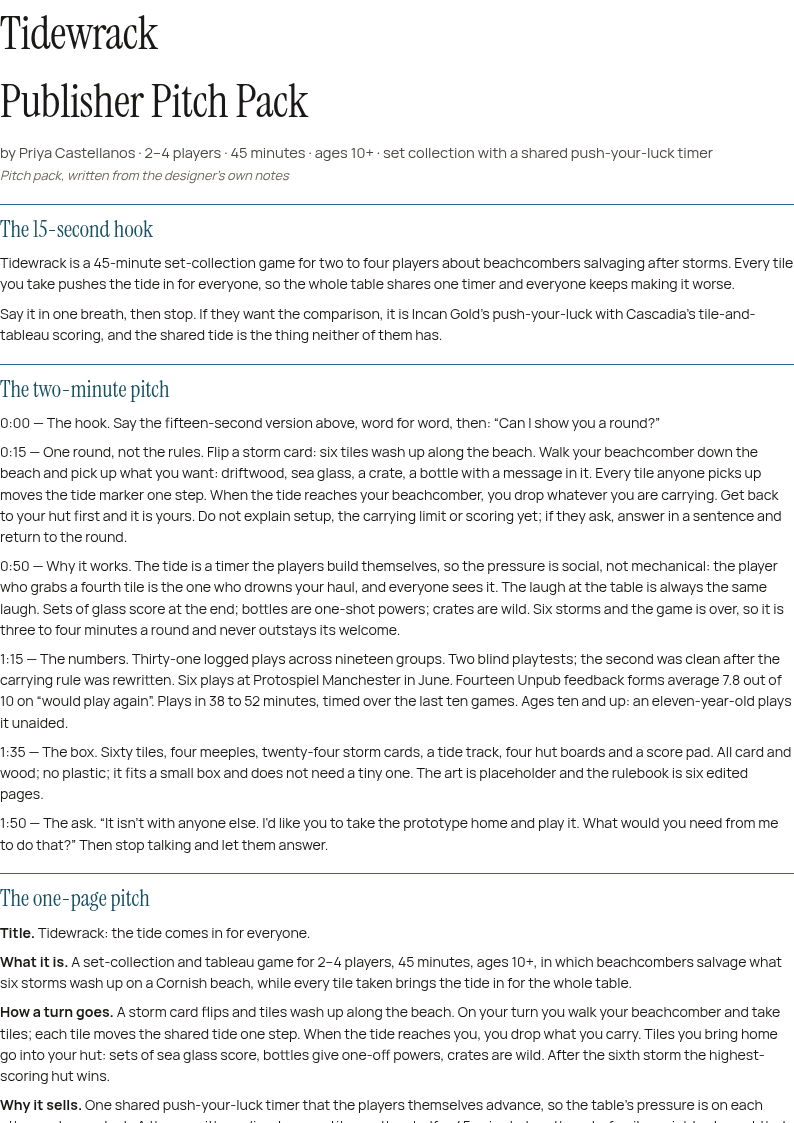
After: the pitch pack.
THE 15-SECOND HOOK
Tidewrack is a 45-minute set-collection game for two to four players about beachcombers salvaging after storms. Every tile you take pushes the tide in for everyone, so the whole table shares one timer and everyone keeps making it worse.
Say it in one breath, then stop. If they want the comparison, it is Incan Gold's push-your-luck with Cascadia's tile-and-tableau scoring, and the shared tide is the thing neither of them has.
THE TWO-MINUTE PITCH
0:00 — The hook. Say the fifteen-second version above, word for word, then: “Can I show you a round?”
0:15 — One round, not the rules. Flip a storm card: six tiles wash up along the beach. Walk your beachcomber down the beach and pick up what you want: driftwood, sea glass, a crate, a bottle with a message in it. Every tile anyone picks up moves the tide marker one step. When the tide reaches your beachcomber, you drop whatever you are carrying. Get back to your hut first and it is yours. Do not explain setup, the carrying limit or scoring yet; if they ask, answer in a sentence and return to the round.
0:50 — Why it works. The tide is a timer the players build themselves, so the pressure is social, not mechanical: the player who grabs a fourth tile is the one who drowns your haul, and everyone sees it. The laugh at the table is always the same laugh. Sets of glass score at the end; bottles are one-shot powers; crates are wild. Six storms and the game is over, so it is three to four minutes a round and never outstays its welcome.
1:15 — The numbers. Thirty-one logged plays across nineteen groups. Two blind playtests; the second was clean after the carrying rule was rewritten. Six plays at Protospiel Manchester in June. Fourteen Unpub feedback forms average 7.8 out of 10 on “would play again”. Plays in 38 to 52 minutes, timed over the last ten games. Ages ten and up: an eleven-year-old plays it unaided.
1:35 — The box. Sixty tiles, four meeples, twenty-four storm cards, a tide track, four hut boards and a score pad. All card and wood; no plastic; it fits a small box and does not need a tiny one. The art is placeholder and the rulebook is six edited pages.
1:50 — The ask. “It isn't with anyone else. I'd like you to take the prototype home and play it. What would you need from me to do that?” Then stop talking and let them answer.
THE ONE-PAGE PITCH
Title. Tidewrack: the tide comes in for everyone.
What it is. A set-collection and tableau game for 2–4 players, 45 minutes, ages 10+, in which beachcombers salvage what six storms wash up on a Cornish beach, while every tile taken brings the tide in for the whole table.
How a turn goes. A storm card flips and tiles wash up along the beach. On your turn you walk your beachcomber and take tiles; each tile moves the shared tide one step. When the tide reaches you, you drop what you carry. Tiles you bring home go into your hut: sets of sea glass score, bottles give one-off powers, crates are wild. After the sixth storm the highest-scoring hut wins.
Why it sells. One shared push-your-luck timer that the players themselves advance, so the table's pressure is on each other, not on a clock. A theme with no direct competitor on the shelf, a 45-minute length and a family-weight rules set that an eleven-year-old handles.
Where it sits. Beside Incan Gold for the push-your-luck and Cascadia for the tile-and-tableau scoring, at a shorter length than either; nearest in feel to a light family game that groups ask to play again straight away.
The numbers. 31 logged plays, 19 groups, 2 blind playtests, 6 plays at Protospiel Manchester (June 2026), 14 Unpub forms averaging 7.8/10 for “would play again”, 38–52 minutes timed over the last 10 plays.
Components. 60 tiles, 4 beachcomber meeples, 24 storm cards, tide track and marker, 4 hut boards, score pad. Card and wood only. Small box.
Status. Rules complete, six-page rulebook professionally edited, placeholder art. Not submitted anywhere else. Seeking a standard royalty publishing deal; no interest in self-publishing.
Contact. Priya Castellanos · email and phone · prototype and rulebook PDF available on request.
TEN QUESTIONS A PUBLISHER ASKS, ANSWERED FROM YOUR NOTES
1. Who is it for? — Families and gaming groups who want a 45-minute game with real decisions: the people who own Cascadia or Incan Gold and want something lighter than the first and meaner than the second. Ages ten and up, confirmed by play, not guessed.
2. What's the hook? — The shared tide. Every tile anyone takes brings the tide in for everyone, so the timer is built by the players and the pressure is social.
3. How long and how many? — Two to four players, 38 to 52 minutes timed over the last ten plays. Best at three and four; two is a tighter, more tactical game.
4. What does it play like? — Incan Gold's push-your-luck inside Cascadia's tile-and-tableau scoring, with the timer shared. Use the comparison when they ask for one, not before.
5. How much has it been tested? — Thirty-one logged plays across nineteen groups, two blind playtests (the second clean after the carrying-limit rule was rewritten), six plays at Protospiel Manchester, fourteen Unpub forms averaging 7.8 out of 10.
6. Has anyone else seen it? — A scout for another publisher played it at Protospiel and asked for it; it has not been sent to anyone. Say exactly that, once, without the name, and move on.
7. Why beachcombing and not pirates? — Because the tide is the game, and the tide only means something on a beach. The theme does the rules' work: anyone who has walked a beach knows what the tide coming in means without reading a line. Pirates would need a timer invented for them.
8. What would it cost to make? — Sixty tiles, four meeples, twenty-four cards, a track, four small boards and a pad; card and wood only, no plastic, small box. The cheap end of the family-game shelf.
9. What is the art situation? — Placeholder sketches by a friend; you expect the publisher to commission the art and have no attachment to the current look.
10. What are you looking for? — A standard royalty deal with a publisher who will take it to retail. Not self-publishing, not a crowdfunding campaign. Open to the publisher's view on the title and the player count.
What we changed, and why.
1. The rules explanation was replaced by one round
Your notes start at setup (“each round a storm card flips…”) and you say people's eyes glaze. The two-minute pitch shows a single turn instead; setup, the carrying limit and scoring are held back until asked.
2. “It's just a little set collection game” was cut
You said you undersell it. The pitch leads with the shared tide, which is the thing testers name, and never calls the game small.
3. The tester's comparison was kept but moved
“Incan Gold meets Cascadia” is useful to a publisher who asks; it is placed as an answer, not an opening, so the hook is yours and not two other games'.
4. The failed blind playtest became a strength
Your notes mention the one that went badly. The pitch says the second blind test was clean after the carrying rule was rewritten: evidence that you fix things.
5. The scout who never replied is mentioned once, without the name
A publisher will ask whether anyone else has seen it. The honest answer (played it, asked for it, nothing sent) is written as one sentence and not raised unprompted.
6. Play time became a range with a method
“About 45 min” became “38 to 52 minutes, timed over the last ten plays”, from your own figure, because a publisher trusts a range with a method over a round number.
7. The pirates question got a one-paragraph answer
You said you do not want pirates but not why. The answer written here argues from the mechanism (the tide is the game) rather than from taste, which is the argument a publisher accepts.
8. The ask was written out
Your notes do not say what you want them to do at the end of the slot. The pitch ends with a specific request (take the prototype home) and a question that hands them the next step.
Questions for the designer.
1. Which publisher is it? The pitch refers to “a mid-size publisher at Essen”. Their catalogue decides the comparison titles: if they publish Cascadia-weight games, lead with the tableau; if their list is lighter, lead with the push-your-luck.
2. Ages 10+ is written from the eleven-year-old nephew. If the eight-year-old could manage it with help, say 8+ with an adult; a publisher's age band is a box fact, so pick one.
3. Best player count: the pack says best at three and four. Confirm from your logs, because they will ask.
4. The scout: do you want their company named if the publisher asks directly? The pack says no name. Say if you would rather name them.
5. Sell-sheet and rulebook: the pitch says both are available on request. Confirm the rulebook PDF is the edited six-page version and that you will bring a printed sell-sheet to the slot.
6. The title: are you open to the publisher renaming it? The pack says yes. Change it if Tidewrack is fixed.
Download the sample PDF The Word file The text file Write my pitch →
The real pack is written from your own notes; the shape is the same.